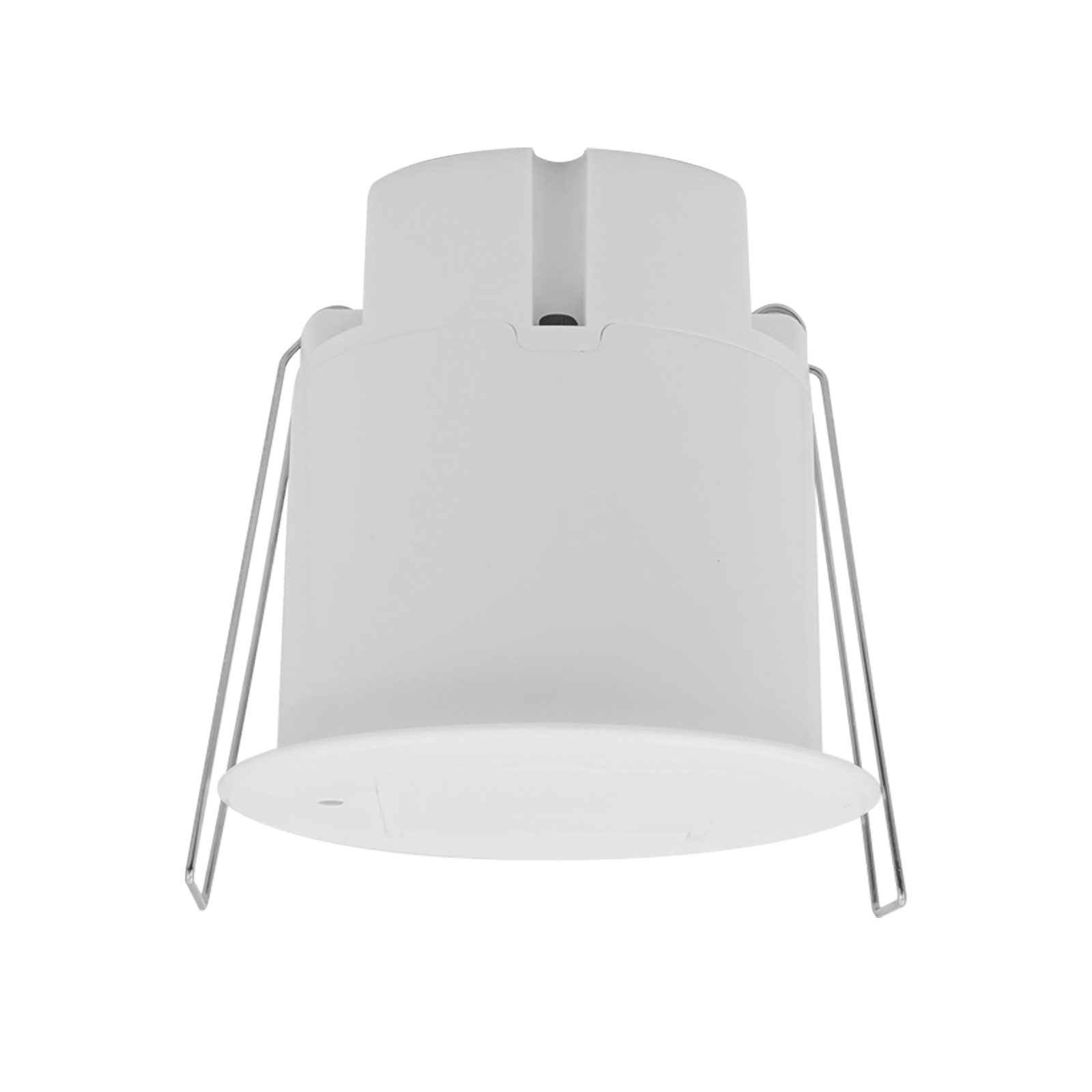
The CTL-SEN-R5/6201 is a flagship human presence sensor powered by advanced 60GHz 4D mmWave radar technology. Featuring a robust 4T4R antenna array, it delivers ultra-high resolution to support complex functions, including real-time trajectory tracking, people counting, fall detection, and precise bed occupancy monitoring (in-bed/out-of-bed status). By capturing minute physiological signals (such as breathing), it ensures reliable performance within a ø6.0-meter coverage area, making it an ideal solution for premium smart home, healthcare, and elderly care applications.
Features
Presence: Detects stationary presence via breathing micro-motions within 5.0 x 6.0m.
Fall Detection: Real-time fall identification via point cloud and posture analysis.
Bed Monitor: Tracks "in-bed" vs. "out-of-bed" status in defined zones.
Zone Alert: Monitors boundaries (e.g., doorways) for entry/exit alerts.
Counting: Real-time counting and location tracking for space management.
Sensitivity and detection distance can be adjusted independently.
Integrated high-precision sensor for accurate indoor illuminance monitoring.
Dual independent dry contact outputs for simultaneous dual-function monitoring.
Adjustable lighting threshold.
Supports parameter configuration and status readout via IR remote control.
Indicator LED brightness automatically adjusts to ambient light levels.
Specifications
Communication Type
Dry Contact
Input Voltage
DC 12 to 30 V
Power Consumption
0.5 W (Max)
Dry Contact Output
Normally Open Mode, Normally Closed Mode, Normally Open Pulse, Normally Closed Pulse
Output Channels
2 Channels (Default: Presence & Fall)
Dry Contact Load
AC or DC ≤ 30 V, ≤ 200 mA
Indicator Light
RGB LED
Detection Mode
60GHz FMCW Radar
Antenna Array
4T4R
Operating Frequency
60 to 64 GHz
Transmit Power
≤ 10 dBm
Installation Method
Recessed Ceiling Mount
Mounting Height
2.0 to 3.2 m
Detection Angle
360°
Detection Coverage
5.0 x 6.0 m
Detection Range
1.0 to 6.0 m (sensor to target)
Sensitivity
0% to 100%
Illuminance Monitoring
0 to 32,000 Lux (Accuracy ±4%)
Delay Time
1 to 3,600 seconds
Product Size
Φ65 mm x 60 mm
Cutout Size
Φ55 mm
Product Weight
70 g
Cable Assembly
UL1007 20AWG Cable Length: 150 mm
Operating Environment
Indoor -20 to 45°C, Humidity < 95% RH (Non-condensing)
Storage Temperature
-40 to 85°C
Protection Level
IP20
Housing Material
PC
Range
Delivering high-precision three-dimensional spatial monitoring at a standard mounting height of 3.0 meters, this 60 GHz eldercare radar sensor provides a horizontal detection range of approximately 5.0 meters x 6.0 meters.
Front View
Top View
Dimensions
Recessed mount, product outer diameter 65 mm, product depth 60 mm, cutout diameter 55 mm.
Product Dimensions
Applications
HomeEldercareHotelLightingOfficeSecurity
Mounting
Interference Avoidance: Avoid installing near constantly moving objects (e.g., curtains, plants) or large reflective surfaces (e.g., metal ducts, mirrors) to prevent false triggering.
Device Spacing: Maintain a minimum distance of 4 meters between multiple sensors to prevent mutual interference.
Mounting: Ensure the installation surface is vibration-free. Note that radar signals can penetrate surfaces; avoid moving objects directly behind the installation wall/ceiling.
Wiring Safety: Disconnect power before wiring. Use certified cables and ensure the circuit includes appropriate short-circuit and overload protection.
Disclaimer: Specifications are subject to change without notice. This product is an auxiliary device, not a medical instrument. The manufacturer is not liable for issues caused by improper installation or misuse.
Wiring Diagram
Debugging
IR Remote Control
Designed for ultimate convenience and efficiency, this product supports quick on-site configuration and parameter reading using an infrared (IR) remote control. Once deployed, debugging and maintenance can be easily accomplished even without relying on a smart home platform.
FAQ
What is the core positioning of this model in hospital or nursing home low-voltage systems?
It provides pure dry contact signal output (without network protocols). Its core purpose is as a lightning-fast hardware alarm source, connected directly in series to traditional medical call hosts or sound/light alarms, achieving zero-delay hardwired trigger alarms when a "fall" occurs.
What is the advantage of internal dual-channel output during monitoring?
The body provides 2 independent dry contact channels (defaulted to presence & fall). This means that via one ribbon cable, two key statuses—whether the patient is "present" and whether a "fall" has occurred—can be sent separately to the nurse station's host simultaneously.
For fall detection, what are the strict requirements for installation location and direction?
First, ensure the installation surface is extremely stable without any vibration. Second, the triangle direction markings on the sensing surface must be strictly aligned parallel to the key coordinate system of the detection area; otherwise, the spatial posture parsing will fail completely.
Are the power supply and dry contact cables led out directly?
The rear of the body provides a 6-core integrated wiring port (PH2.0), containing DC 12-30V power input and dual-relay dry contact outputs, plug-and-play.
Can the internal dry contact be connected in series to directly control a 220V siren?
Absolutely not. The dry contact can only withstand a maximum low-voltage signal of 30V/200mA. To control 220V high-voltage components, an external high-voltage relay or AC contactor conversion must be connected.
The back of the body has no dials or pairing keys; how is the configuration adjusted on-site?
You must use the RC1 infrared remote controller aimed directly at the multi-function window on the sensing surface to issue commands contactlessly for combinational blind adjustment modifications of parameters like sensitivity and delay.
Will installing on a metal ceiling in a ward affect fall detection?
It will cause detection to be completely paralyzed. Large metal plates thoroughly reflect and shield 60G millimeter waves; the massive disordered echoes generated will completely destroy the radar's internal 4D point cloud mapping. The sensing surface must protrude from the metal frame
Is ambient illuminance detection integrated?
The hardware contains a high-precision illuminance sensor, but for the pure dry contact model without a network, this illuminance data is primarily used locally for judging light intensity thresholds and does not output value packets externally.